News

Sulfonated Castor Oil vs Castor Oil Ethoxylate: What Should Buyers Know?

2026-10-16 0 Leave me a message


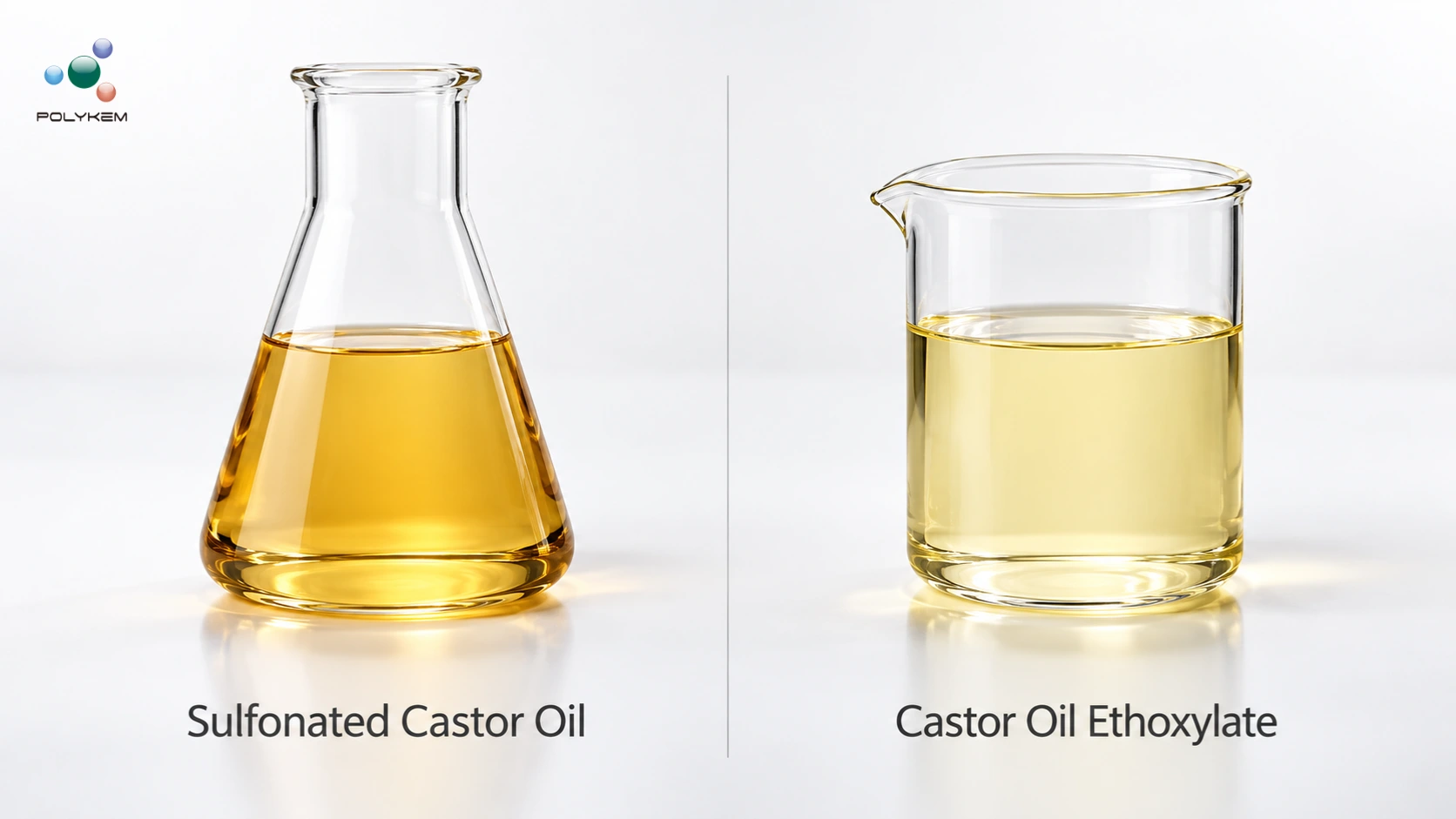
Sulfonated Castor Oil and Castor Oil Ethoxylate are both derived from castor oil. They are used in textile processing, industrial emulsification and other chemical formulations, but they do not behave in the same way.


The main difference comes from how they are chemically modified. This affects their ionic properties, compatibility with other ingredients and suitability for different applications.


Anionic vs Nonionic: What Changes?


Sulfonated Castor Oil, also known as Turkey Red Oil, is an anionic surfactant. Its chemical modification introduces hydrophilic groups, allowing the oil-derived material to disperse in water. It is used in formulations requiring wetting, penetration and oil-in-water emulsification.


Castor Oil Ethoxylate is a nonionic surfactant produced by adding ethylene oxide to castor oil. Its properties vary with the degree of ethoxylation. Lower EO grades generally have greater affinity for oils, while higher EO grades tend to be more hydrophilic.


The distinction matters when choosing emulsifiers for systems containing salts, metal ions or other surfactants. Nonionic ethoxylates generally offer greater flexibility in ionic compatibility, although their performance can still be affected by temperature and formulation conditions.


Where Are the Two Products Used?


In textile processing, Sulfonated Castor Oil can serve as a wetting and penetrating agent. It is also used in leather fatliquoring, where water dispersibility helps introduce oily components into the leather fibre structure. Certain metalworking fluid formulations use it for emulsification and supplementary lubrication.


Castor Oil Ethoxylate is commonly considered for emulsification, solubilization and wetting in industrial cleaning, textile auxiliaries, agrochemical formulations and metalworking fluids.


Polykem offers EL-10, EL-20, EL-40 and EL-80 grades of Castor Oil Ethoxylate. The EO level provides a useful starting point when matching an emulsifier to a particular oil phase, but final selection still requires formulation testing.


Can Sulfonated Castor Oil Replace Castor Oil Ethoxylate?


Not necessarily. Even when both products are used as emulsifiers, replacing one with the other may change emulsion stability, viscosity or compatibility with other ingredients.


For systems requiring an anionic wetting agent with good water dispersibility, Sulfonated Castor Oil may be suitable. Where nonionic compatibility or a choice of EO grades is important, Castor Oil Ethoxylate may offer more options.


Buyers should check the oil phase, water quality, operating temperature and other formulation components before selecting either product.

Polykem supplies both castor oil derivatives for industrial applications. Product specifications, COA, TDS and SDS are available to support evaluation, together with samples upon request.


For grade information, samples or quotations, please contact Polykem.


Related News
Leave me a message
X
We use cookies to offer you a better browsing experience, analyze site traffic and personalize content. By using this site, you agree to our use of cookies. Privacy Policy
RejectAccept