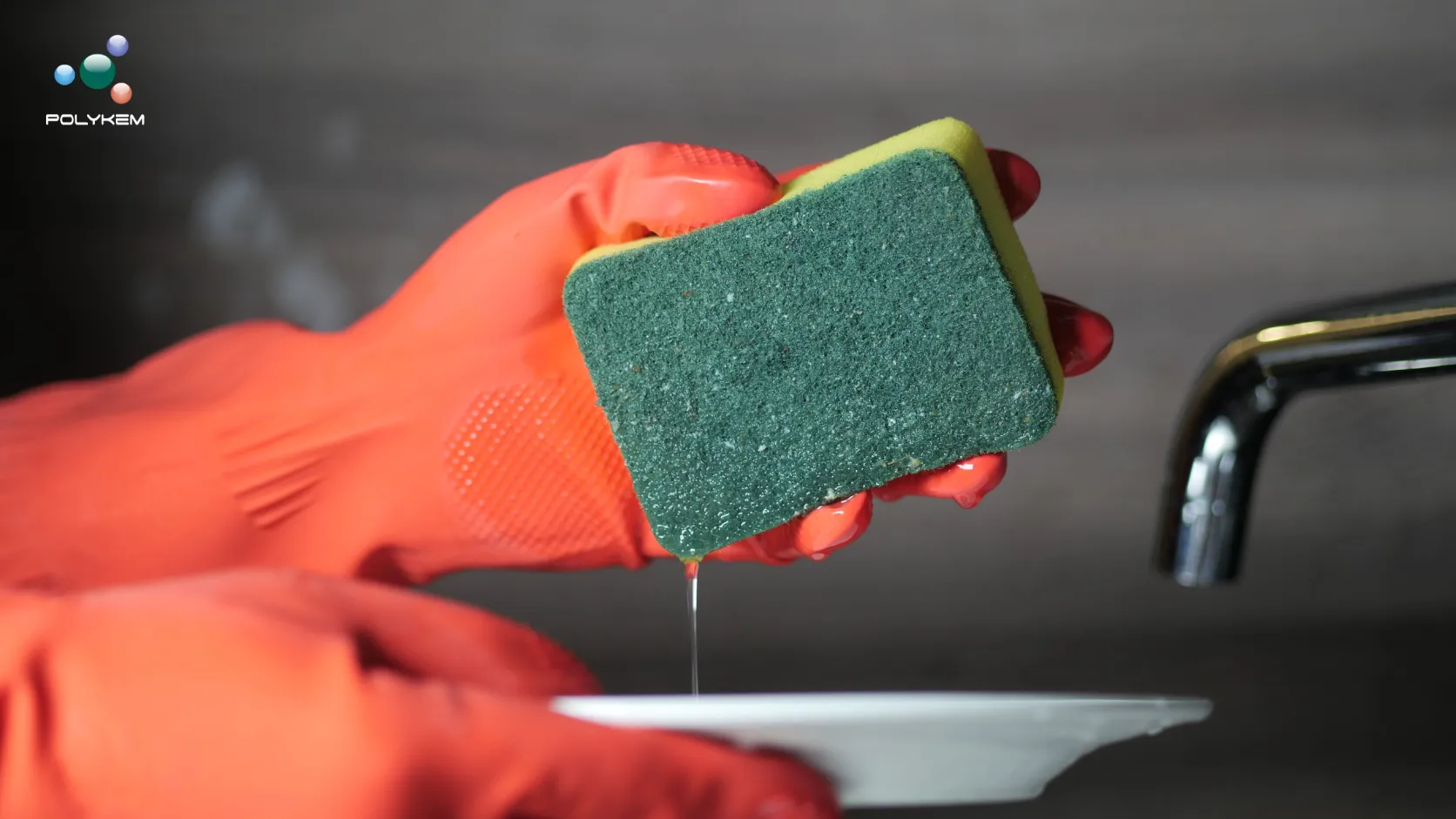
A dishwashing liquid has to remove grease, spread quickly across wet surfaces and produce foam that lasts long enough for hand washing. Relying on one surfactant rarely delivers all three. This is why Cocamidopropyl Betaine (CAPB) is often used as part of a mixed surfactant system rather than as the main cleaning ingredient.
CAPB is an amphoteric surfactant supplied as a light-yellow transparent liquid. In dishwashing formulations, it is mainly valued for the way it changes foam, viscosity and the overall balance of the formula.
What Does CAPB Add to Dishwashing Liquid?
The primary surfactant does most of the heavy cleaning. CAPB supports that work by improving surface wetting and helping the wash solution lift food residues and light grease from plates, cookware and utensils.
Its effect is often more noticeable during use than in a specification table. Foam can feel denser and collapse less quickly when oil enters the sink. The liquid may also spread more evenly across a sponge instead of draining away immediately.
CAPB is therefore useful in hand dishwashing liquids where cleaning performance and the washing experience both matter. It is not a substitute for an effective primary detergent, but it can make the complete system work more evenly.
Pairing CAPB with SLES
A common approach is to combine CAPB with an anionic surfactant such as Sodium Lauryl Ether Sulphate (SLES). SLES supplies much of the detergency and initial foam, while CAPB helps adjust foam texture and persistence.
This pairing can also make viscosity adjustment more practical. In suitable anionic–amphoteric systems, CAPB changes the micelle structure and may improve the response to salt. That does not mean more CAPB or more salt will always produce a thicker liquid. Once the formulation passes its optimum range, viscosity may stop rising or begin to fall.
For this reason, formulators usually build a salt curve instead of selecting the electrolyte level by guesswork. Surfactant ratio, active matter, fragrance and temperature all affect the result.
When Might APG Be Added?
For some products, Alkyl Polyglucoside (APG) can be introduced as another co-surfactant. APG is nonionic and offers useful wetting and detergency, but it does not behave exactly like CAPB.
CAPB is often chosen when the priorities are foam modification, compatibility with anionic surfactants and viscosity building. APG may be considered when formulators want additional nonionic cleaning or a different raw-material profile. A formula may contain either one or both, depending on its target cost, foam and grease-removal performance.
Checking the Finished Formula
A clear product on the mixing day is not enough to confirm stability. Dishwashing liquid should also be observed after storage at different temperatures. Fragrance, colorants, preservatives and electrolytes may change clarity or viscosity over time.
Foam testing should include an oily load as well. A formula that looks impressive in clean water may lose foam quickly once it contacts cooking oil. Comparing several surfactant ratios under the same conditions gives a more useful result than evaluating CAPB alone.
Polykem supplies CAPB, SLES, APG and other surfactants for household and industrial cleaning products. Specifications, COA, TDS, SDS and sample support are available for formulation trials and supplier evaluation. Contact polykem now!