A shirt collar, a splash of cooking oil and ordinary dust do not respond to washing in quite the same way. This is why most liquid laundry detergents rely on more than one surfactant. In such systems, AEO-9 is often used to improve the removal of oily soils while working alongside anionic surfactants.
AEO-9 is a fatty alcohol ethoxylate with approximately nine ethylene oxide (EO) units. As a nonionic surfactant, it provides wetting and emulsification properties that complement the cleaning performance of other detergent ingredients.
Removing Oily Stains from Fabric
Water alone has difficulty wetting and carrying away grease. AEO-9 helps lower the surface tension of the washing solution and emulsifies oil released from the fabric. Once dispersed into the wash water, oily soil is less likely to deposit back onto the fibres.
This makes AEO-9 useful for laundry products designed to handle body oils, food grease and stains around collars or cuffs. Its relatively hydrophilic character also makes it easier to incorporate into water-based liquid detergents than lower-EO grades.
Actual cleaning performance still depends on the complete formula. Surfactant concentration, washing temperature, fabric type and the age of the stain all influence the result.
Working with Other Surfactants
AEO-9 is commonly blended with anionic surfactants such as SLES, which contribute detergency and influence the foam profile of the finished product.
The two serve complementary functions. Anionic surfactants provide general cleaning performance, while AEO-9 supports wetting and oil emulsification. This combination can help improve oily soil removal without relying solely on a higher concentration of one surfactant.
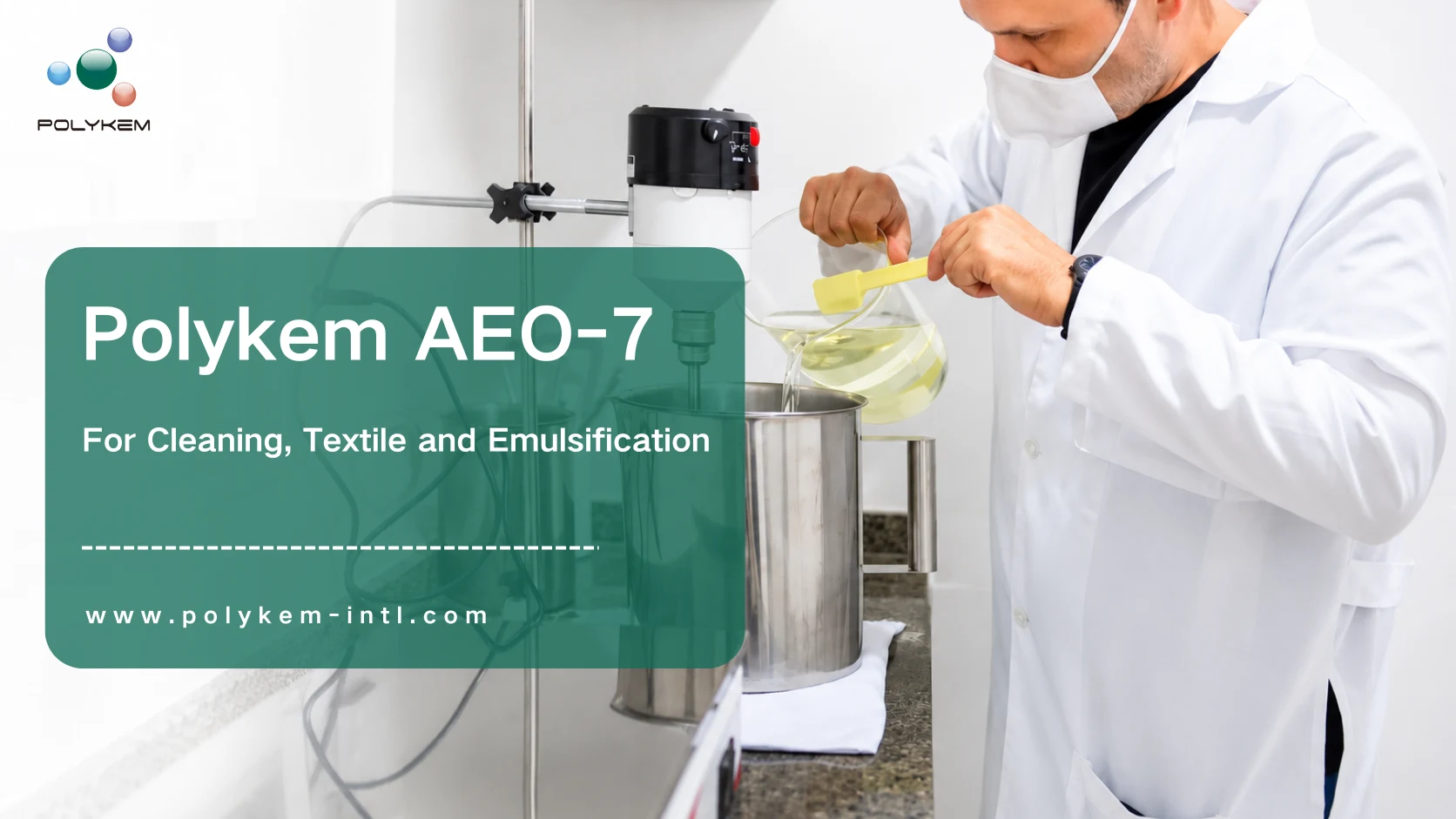
Other nonionic surfactants, including AEO-7, may also be considered. With fewer EO units, AEO-7 generally has greater oil affinity, while AEO-9 is more hydrophilic. The choice depends on the required balance between detergency, water compatibility and formulation stability.
AEO-9 vs C13 Alcohol Ethoxylate: What Is the Difference?
Both AEO-9 and C13 Alcohol Ethoxylate are nonionic surfactants used for wetting, detergency and oil emulsification. However, their alcohol structures are different.
AEO-9 is based on lauryl alcohol with approximately nine EO units, while C13 Alcohol Ethoxylate is derived from synthetic C13 alcohol. Polykem offers several C13 AE grades, including 1307, 1309 and 1310, with different degrees of ethoxylation.
In laundry formulations, both may be considered for oily soil removal and blending with anionic surfactants. C13 AE provides more options for adjusting oil affinity and water compatibility through grade selection, while AEO-9 offers a relatively hydrophilic starting point for liquid detergent systems.
Neither is necessarily better at removing stains. Their performance should be compared under similar washing conditions, taking into account cleaning efficiency, foam behaviour and formulation stability.
Foam and Formula Stability
More foam does not automatically mean cleaner laundry. Hand-washing detergents may need visible, lasting foam, whereas products for automatic washing machines generally require tighter foam control.
The final foam profile depends on the complete surfactant blend, including the ratio of AEO-9 to anionic ingredients.
Stability also needs to be checked after the full formula is assembled. Electrolytes, builders, fragrances, enzymes and polymers may affect viscosity or clarity.
Temperature matters as well. According to Polykem's product specifications, AEO-9 may appear as a white liquid or paste at 25°C. Production conditions and the order of addition should therefore account for its physical form.
Before confirming a formulation, laboratory trials should evaluate cleaning performance, foam, viscosity and storage stability under the intended conditions.
AEO-9 Supply from Polykem
Polykem supplies AEO-9 and other Lauryl Alcohol Ethoxylate grades for laundry detergents, household cleaners and industrial formulations.
Product specifications, COA, TDS, SDS and samples are available to support grade comparison and formulation testing.
For AEO-9 specifications, sample requests or quotations, please contact Polykem.