News

Polyoxyethylene Sorbitan Fatty Acid Ester (TWEEN) Sourcing Guide: Grades, Specifications and Quality Checks

2026-07-28 0 Leave me a message


TW-20, TW-40, TW-60 or TW-80—which grade fits your application requirements, and what should you check before approving an order?


The answer depends on more than the product name. Buyers need to compare appearance, acid value, water content, HLB, batch documents and test performance. This guide explains how to review Polyoxyethylene Sorbitan Fatty Acid Ester for coatings, textiles, agrochemicals and other industrial formulations.


Confirm the Required TWEEN Grade


The TWEEN series includes nonionic surfactants with different fatty acid components, HLB ranges and physical forms. Each grade offers its own balance of emulsification, wetting, dispersion and solubilization.


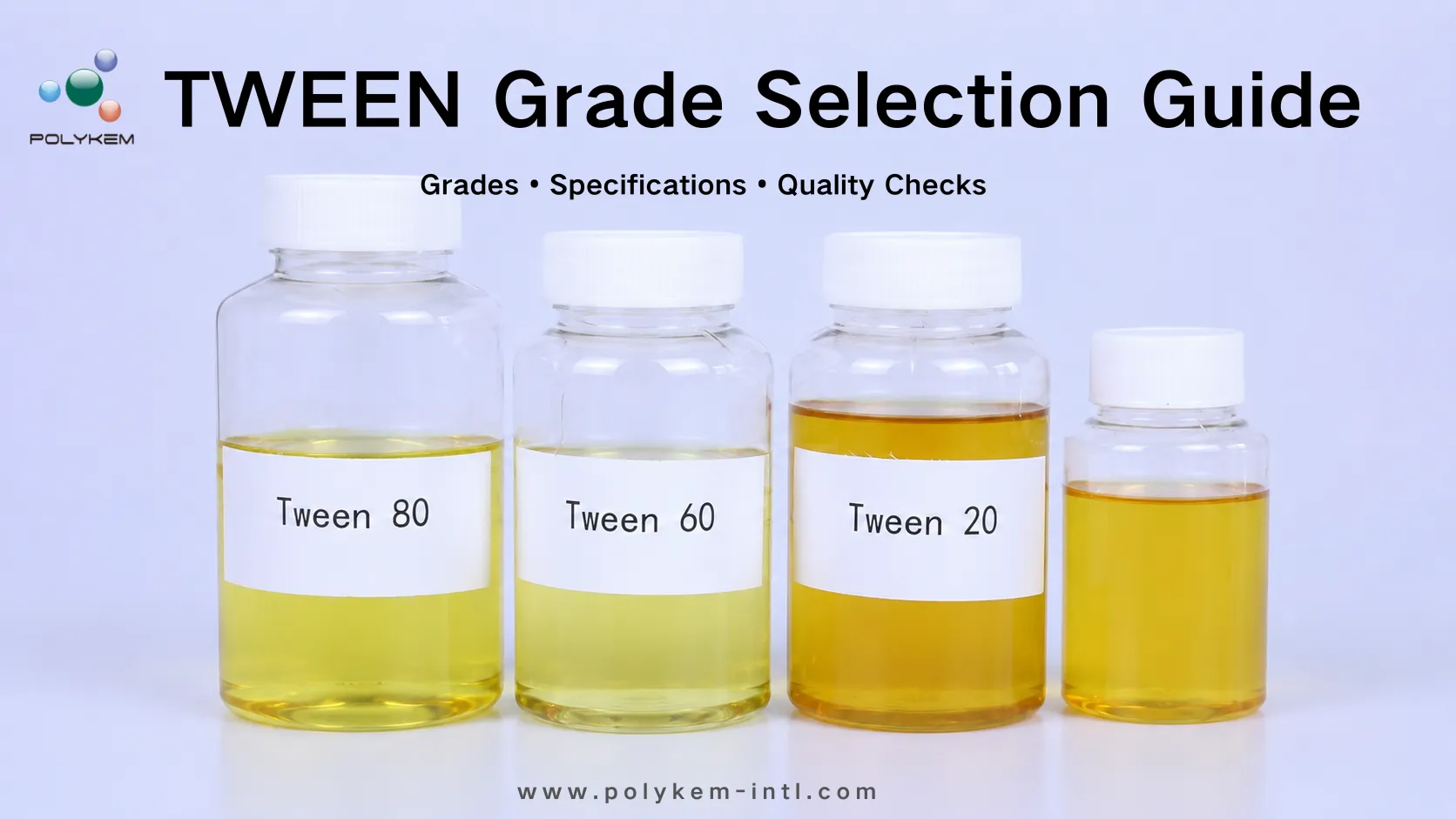
Polykem supplies TW-20, TW-40, TW-60 and TW-80 grades for different industrial application requirements.


Before placing an inquiry, buyers should confirm the required grade and intended use. If the material is being evaluated for a new application, information such as the oil phase, processing temperature and required function can help suppliers provide more suitable recommendations.


Quick TWEEN Grade Reference


Grade
Main fatty acid component
HLB
Water limit in Polykem’s current specification
TW-20
Laurate
16.5
≤2.0%
TW-40
Palmitate
15.5
≤2.5%
TW-60
Stearate
14.5
≤3.0%
TW-80
Oleate
15.0
≤2.5%


This table is an initial purchasing reference. Confirm the current specification and batch COA for the selected grade before ordering.


For hydroxyl value, saponification value, acid value and other technical data, view Polykem’s Polyoxyethylene Sorbitan Fatty Acid Ester (TWEEN) product page.


Check Appearance Under Comparable Conditions


Appearance is usually the first check during sampling and incoming inspection. However, the appearance of TWEEN products can vary depending on the grade and storage temperature.


The TWEEN series may appear as a yellow-to-amber oily liquid or a more viscous material. For example, TW-60 may show higher viscosity or a paste-like appearance under certain conditions, which does not necessarily indicate a quality issue.


When comparing samples, check them under the same temperature and observation conditions. Buyers should pay attention to:


  • Unusual darkening
  • Visible foreign matter
  • Unexpected separation
  • Significant differences from the approved sample


Appearance alone cannot confirm product quality, but unexpected changes may indicate that further inspection is needed.


Review Acid Value and Water Content


Acid value and water content are important specifications when evaluating Polyoxyethylene Sorbitan Fatty Acid Ester.


Acid value provides information about free acidity in the material and should be checked against the specification of the selected grade.


Water content can affect handling and processing consistency, especially in applications where moisture control is important. Different TWEEN grades may have different specification requirements, so buyers should review the corresponding TDS and COA values for the supplied batch.


Other parameters, such as hydroxyl value and saponification value, may also be included depending on the grade and quality requirements.


Use HLB as a Selection Reference


HLB value is commonly used as a reference when selecting nonionic surfactants for emulsification and dispersion applications.


A suitable HLB range can help buyers narrow down possible TWEEN grades during initial evaluation. However, HLB alone cannot guarantee final performance.


Actual results may also depend on raw material compatibility, concentration, processing conditions and other components in the system.


For replacement projects, a similar HLB value does not always mean identical performance.


Test the Product in the Intended Application


Technical specifications can help narrow down suitable TWEEN grades, but application testing is still an important step before bulk purchasing.


Testing should be performed under conditions close to the actual production environment, including raw materials, dosage, water quality, mixing process and temperature.


Depending on the application, buyers may focus on:

Coatings and polymer systems: wetting, dispersion stability and compatibility.

Textile processing: penetration performance and bath stability.

Agrochemical applications: dilution behavior and emulsion stability.


Keeping the approved sample and test records can also help maintain consistency when evaluating future batches.


What Polykem Can Provide Before You Order


Polykem supplies the four TWEEN grades covered above for coatings, textiles, agrochemicals, oilfield chemicals and other industrial applications.


Before ordering, Polykem can provide:

 - Grade and specification information

 - COA, TDS and SDS documents

 - Samples for evaluation

 - Packaging and MOQ information

 - Estimated production and delivery time

 - Export and logistics coordination

 - Quotations for regular and bulk orders


Before confirming an order, buyers should ensure that the selected grade and specifications in the quotation, TDS and COA match the required application conditions.


Contact Polykem to request product information or discuss your TWEEN sourcing requirements.


Related News
Leave me a message
X
We use cookies to offer you a better browsing experience, analyze site traffic and personalize content. By using this site, you agree to our use of cookies.Privacy Policy
RejectAccept