When working with polyethylene glycol for the first time, one question often comes up: Why is PEG 400 a liquid, while PEG 1500 is waxy and PEG 6000 is generally supplied as flakes, granules, or powder?
The main reason is PEG molecular weight. It affects not only the physical form of the product at room temperature but also how it is stored, transferred, measured, dissolved, and incorporated into a formulation. Choosing the right PEG grade therefore requires more than simply comparing product numbers.
What Do the Numbers in PEG Grades Mean?
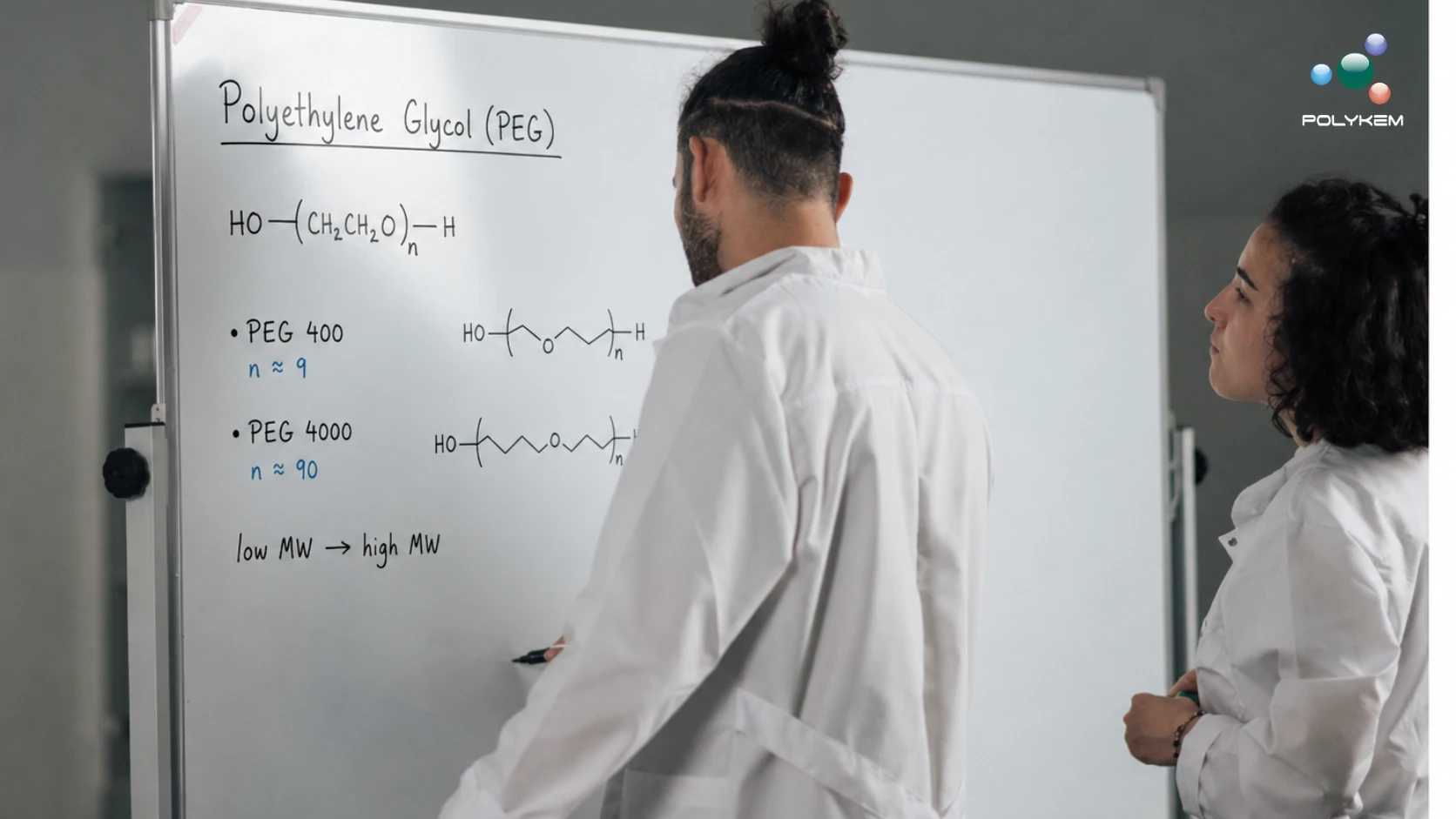
PEG stands for Polyethylene glycol, a polymer made up of repeating ethylene oxide units. The number in product names such as PEG 400, PEG 1000, and PEG 6000 generally indicates the approximate average molecular weight—not the purity or concentration of the product.
As the molecular chain becomes longer, intermolecular interactions and crystallization tendency generally increase. As a result, the physical form of PEG gradually changes from a free-flowing liquid to a semi-solid or waxy material, and eventually to a solid.
At around room temperature, common PEG grades typically appear as follows:
PEG molecular weight
Typical physical form
Processing characteristics
PEG 200–400
Clear liquid
Easy to pump, meter, and mix
PEG 600
Viscous liquid or semi-solid
Sensitive to ambient temperature
PEG 1000–1500
Waxy or solid
May require heating before processing
PEG 2000–8000
Flakes, granules, or powder
Suitable for solid feeding or melt processing
Higher-molecular-weight PEG
Solid
Usually requires more time to melt or dissolve
These ranges should be treated as general guidance rather than fixed boundaries. Actual PEG physical form can also vary with temperature, molecular weight distribution, water content, and the manufacturing process. The same molecular weight may be supplied as powder, flakes, prills, or granules to suit different production requirements.
How Does PEG Molecular Weight Affect Processing?
Low-molecular-weight PEG grades offer good fluidity. PEG 200 and PEG 400 can normally be pumped and metered at room temperature, making them convenient for liquid blending systems. In coatings, inks, personal care products, and industrial formulations, these grades are often used as solvents, carriers, humectants, or plasticizers.
As PEG molecular weight increases, room-temperature fluidity decreases. Grades such as PEG 1000 and PEG 1500 may be waxy or solid depending on the season and production environment. If they are handled through tanks and pipelines, heating, insulation, and line cleaning need to be considered.
Solid grades such as PEG 4000 and PEG 6000 are commonly supplied as flakes, granules, or powder:Powder disperses readily and works well in dry blends, but it may create dust or absorb moisture.Flakes generate less dust, although flake size may affect metering accuracy and dissolution time.Granules generally offer good flowability and are suitable for automated feeding systems.
A higher molecular weight does not necessarily mean that PEG is poorly soluble in water. Common PEG grades remain water-soluble, but solid material must first be wetted and dispersed before it can dissolve. Particle size, water temperature, agitation, concentration, and order of addition can all affect the actual dissolution rate.
Adding too much solid PEG at once may lead to lump formation at the liquid surface. Gradual addition under adequate agitation is usually more effective.
Choosing the Right PEG for Your Process
PEG molecular weight influences far more than the product name. It affects physical form, viscosity, melting behavior, feeding method, dissolution, storage, and overall production efficiency.
The highest molecular weight is not automatically the best choice. A suitable PEG grade should match the intended function of the formulation as well as the available equipment and processing conditions.
Polykem offers a comprehensive range of PEG products covering different molecular weights and physical forms, including liquids, flakes, granules, and powders. If you are unsure which PEG grade fits your application, our technical team can assist with product selection based on your intended use, processing temperature, feeding method, and target performance.
Contact Polykem for PEG specifications, product recommendations, and sample support.