News

Why Octylphenol Ethoxylate Is Used in Low-Foam Industrial Cleaning Systems

2026-07-13 0 Leave me a message


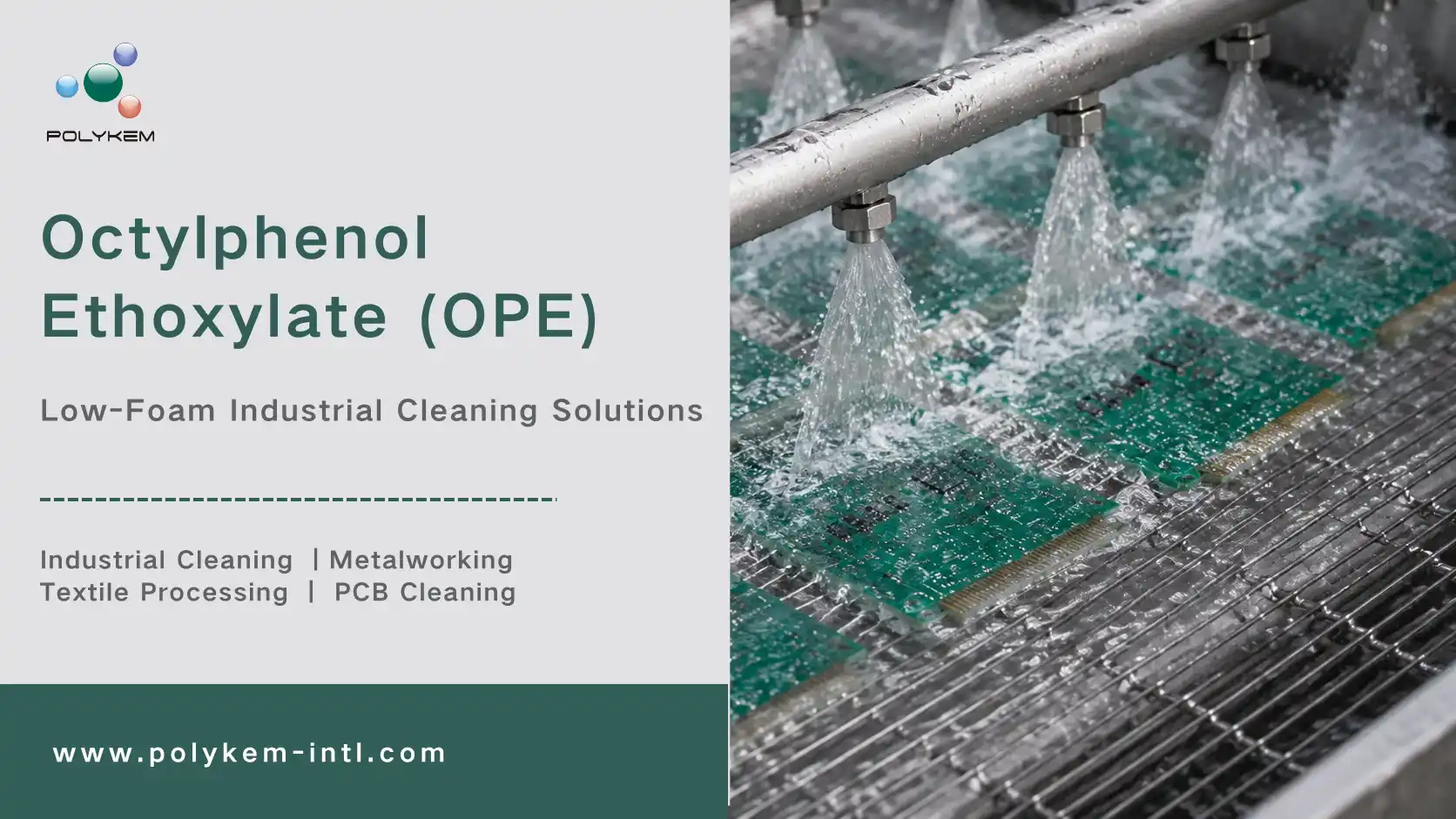
In many industrial cleaning processes, foam is not a sign of better performance. In circulating cleaning units, spray systems or equipment washing, excessive foam can slow drainage, interfere with pumps and make rinsing harder.


This is one reason Octylphenol Ethoxylate (OPE, CAS 9036-19-5) is still discussed in industrial cleaning. As a nonionic surfactant, it combines wetting, emulsification and dispersing performance with a relatively low-foam profile. Polykem’s OPE product range is also designed for use across a broad pH range of 2–13 and offers good resistance to electrolytes, which matters in cleaning systems containing salts, alkalis or other process chemicals.


Why Foam Control Matters


A cleaner used by hand can tolerate some foam. A cleaner moving continuously through pipes, tanks or spray nozzles usually cannot.


Too much foam may reduce effective circulation, affect liquid-level control and increase the time needed for rinsing. In metal cleaning, circuit board cleaning and other equipment-based processes, the surfactant must wet the surface and loosen oil or residue without creating a large foam layer.


OPE is used in these situations because it can support cleaning and emulsification while keeping foam at a more manageable level. This makes it suitable for circulating cleaning systems and other industrial operations where equipment performance matters as much as visible detergency. Polykem specifically lists metalworking fluids and circuit board cleaners among its OPE applications.


Performance in Acidic, Alkaline and Electrolyte-Rich Systems


Industrial cleaners do not always operate under neutral conditions. Some are acidic, some are strongly alkaline, and others contain salts or process residues that may reduce surfactant stability.


Polykem’s Octylphenol Ethoxylate is suitable for a pH range of 2–13 and is described as having strong electrolyte resistance. In practice, this gives buyers more flexibility when evaluating the material for acidic cleaners, alkaline degreasers, metalworking fluids or other systems where conductivity and salt content are relatively high.


That does not mean one grade will behave identically in every cleaner. Working temperature, oil type, water hardness and the rest of the surfactant package still need to be checked. But a wide pH range and electrolyte tolerance make OPE a practical material to test when a conventional surfactant becomes unstable under harsher process conditions.


Where OPE Is Commonly Used


Industrial cleaning is only one direction.


In textile processing, OPE may be used in dyeing and leveling agents or pretreatment products where wetting and dispersing are needed. In emulsion polymerization, it can act as a nonionic emulsifier. It is also used in oilfield chemical systems, including demulsifier components, and in pesticide preparations where emulsification is required.


These applications do not all use OPE in the same way. A circuit board cleaner may focus on low foam and residue removal, while a textile auxiliary may place more weight on wetting and electrolyte resistance. In emulsion polymerization, compatibility with the monomer and other emulsifiers becomes more important.


What Buyers Usually Check


When sourcing Octylphenol Ethoxylate for industrial use, buyers normally review more than the product name.


Common points include:


  • OPE grade or EO level
  • Appearance and colorWater solubility
  • Emulsifying and wetting performance
  • Foam level
  • pH operating range
  • Electrolyte resistance
  • Packaging and shipment method
  • COA, TDS and SDS availability


Polykem’s product is supplied as a light pale-yellow liquid, with a listed density of 1.06 g/mL at 20°C. Packaging options include IBC, drums and tanker delivery, depending on the order.


Octylphenol Ethoxylate and Related Surfactants from Polykem


Polykem supplies a complete range of Octylphenol Ethoxylate grades, including OP-4, OP-7, OP-9, OP-10 and OP-20, for industrial cleaning, textile auxiliaries, emulsion polymerization, oilfield chemistry and related applications.


For customers comparing different nonionic surfactants, Polykem also provides Alcohols C10 Ethoxylate, Alcohols C13 Ethoxylate, Alkyl Polyglucoside (APG), Castor Oil Ethoxylate and other surfactant materials. These products differ in carbon-chain structure, EO range, foam profile and application direction, so selection should be based on the actual system rather than product name alone.


For product details, samples and quotation support, please contact Polykem at Email: dotachem@polykem.cn.


Related News
Leave me a message
X
We use cookies to offer you a better browsing experience, analyze site traffic and personalize content. By using this site, you agree to our use of cookies.Privacy Policy
RejectAccept